
Permitting a New Jersey project under old code assumptions is a fast way to stall a Certificate of Occupancy. Visual inspection alone no longer satisfies the state’s air-sealing requirements, and a missed third-party blower door or duct test can hold up sign-off on a schedule that has no room for delays.
New Jersey adopted the 2021 IECC energy subcode on September 6, 2022, and enforcement became mandatory for all permits filed on or after March 6, 2023. The update raised ceiling and wall R-values, tightened fenestration U-factors, and added mandatory third-party blower door and duct leakage testing on top of the visual inspection builders were used to. Let’s look at what changed and what it means for planning a project from framing through final inspection.
Builders working across New Jersey’s two climate zones need a partner who tracks both the R-value tables and the testing documentation. It is important to find a team that is versed in new home insulation specs and installs to the current code on every job, so nothing gets caught at inspection.
What Changed Under New Jersey’s 2021 IECC Energy Subcode
Effective dates builders need to know
New Jersey’s adoption of the 2021 IECC New Jersey subcode on September 6, 2022, replaced the 2018 edition. The state built in a six-month grace period, so enforcement became mandatory for all permit applications filed on or after March 6, 2023. Any project permitted since that date must meet the updated insulation and testing standards, regardless of when design work started.
Two climate zones, verified by county
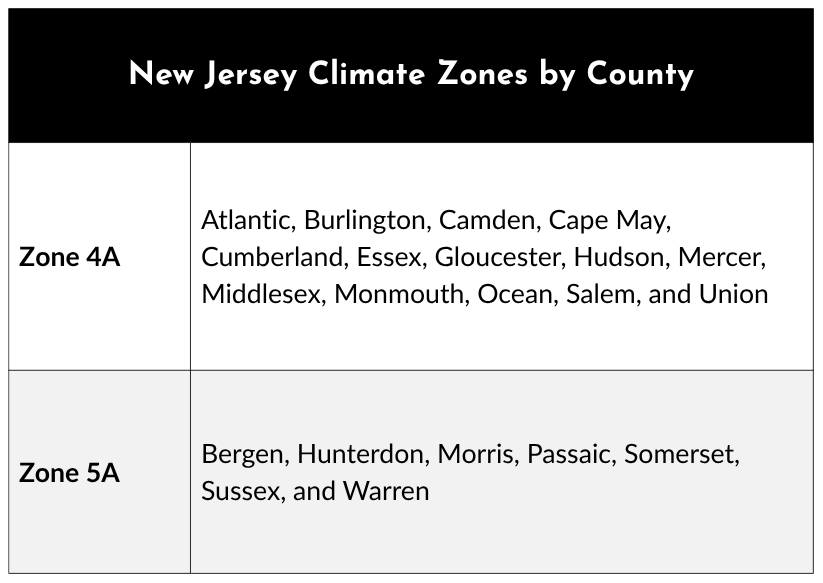
The NJ energy subcode splits the state into two climate zones, zones 4A and 5A. Each zone is set by county, not by city or region.
Here’s a quick breakdown:
Be sure to confirm the correct New Jersey climate zone 4A or 5A insulation requirements at the county level before beginning your project to prevent a rejected permit application later.
What the R-value table requires
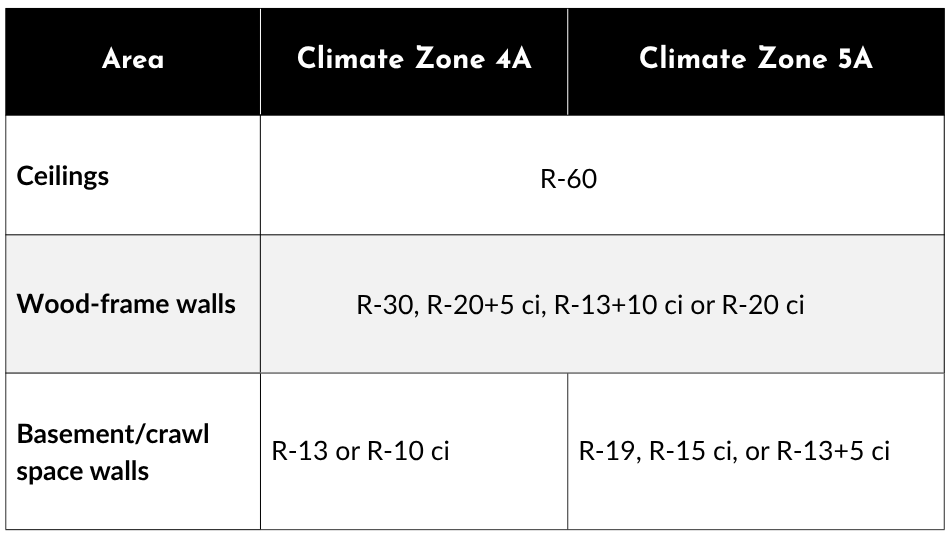
Under the prescriptive package, the updated energy subcode requires:
The updated subcode increased wall and ceiling insulation levels across every New Jersey climate zone from previous requirements. For tract and production builders, new home insulation planning must start with these tables, not the previous code’s lower thresholds.
Mandatory Testing — Blower Door and Duct Leakage
Why visual inspection alone no longer works
Building thermal envelope tightness must now be verified two ways, through visual inspection and through testing. The prior visual-inspection-only option is no longer allowed, and air leakage testing is now a code requirement on every applicable project.
Blower door test specifics
The NJ blower door test requirement calls for testing performed according to ANSI/RESNET/ICC 380, ASTM E779, or ASTM E1827. The test must be conducted by a party independent of the insulation installer and approved by the code official. Documentation must show air leakage under 3 air changes per hour at 50 Pascals for new construction other than additions. Results become part of the permit file through the air sealing scope of work and the NJ air barrier and insulation checklist (Form UCC-F392).
Duct tightness testing
Duct leakage testing for New Jersey buildings must verify duct tightness, regardless of where the ductwork sits. The builder chooses whether to test at rough-in or after construction is complete. Each time carries its own tradeoffs for access and pass rates. Framing cavities can no longer be used as ducts or plenums for supply or return air under the updated code. This changes how mechanical contractors have to route systems on tighter floor plans.
Additional efficiency package still required
Beyond insulation and testing, new construction, other than additions, must include one added efficiency package. Builders can choose from:
- An enhanced envelope option
- More efficient HVAC equipment
- Reduced energy use in water heating
- An improved duct thermal distribution system
- Better air sealing paired with efficient ventilation
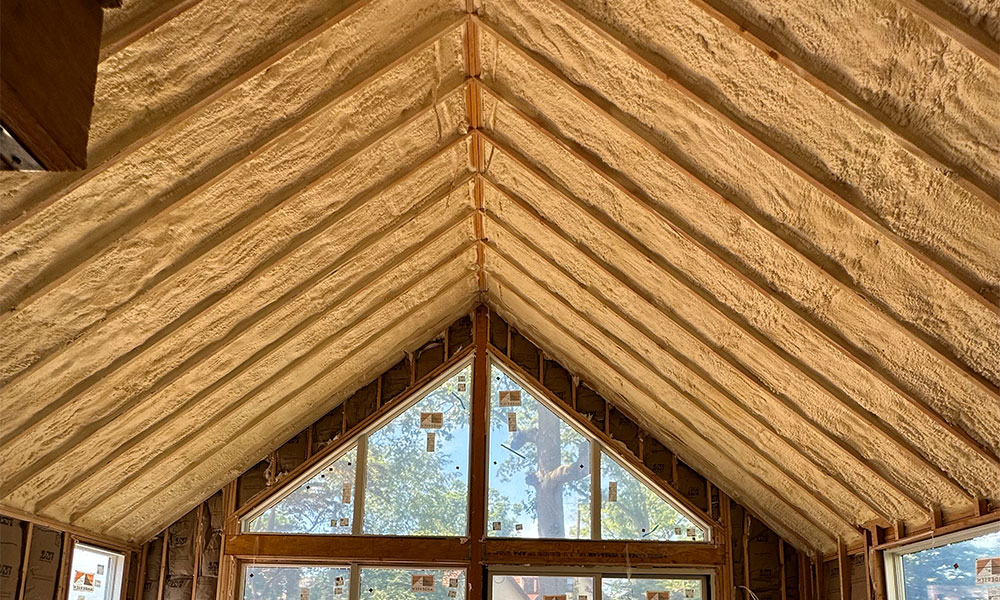
Spray foam insulates and air-seals in a single application, which satisfies both the insulation requirement and the air-sealing option in one step on building projects.
What It Means for Builders, GCs and Multifamily Developers
Documentation and sign-off
Compliance documentation must be signed and sealed by a design professional. The only exceptions are Class 3 buildings, where the HVACR contractor may sign, and owner-occupied single-family homes, where the homeowner may sign.
How building height changes the rulebook
Low-rise residential construction follows the residential IECC-R and the R-value tables covered above. This includes one- and two-family homes or multifamily buildings three stories or less. Anything taller counts as commercial, including multifamily buildings four stories or more. Builders of these structures must comply with ASHRAE 90.1 instead.
New Jersey deleted the IECC’s commercial provisions outright, so commercial and multifamily energy code compliance in NJ depends entirely on unit height once a project crosses that three-story line. A commercial building inspection verifies that installed insulation, lighting fixtures and controls, and mechanical systems all match the approved plans. It is important that multifamily insulation meets the correct standard from the start, so a design doesn’t get caught switching code paths mid-permit.
Why this matters for production schedules
A single missed blower door or duct test on multi-unit and phased builds can delay the issuance of a Certificate of Occupancy across an entire phase, not just the one unit that failed. That is a real scheduling and budget risk that general contractors must face.
The building envelope carries the same importance on residential phases that it does on commercial builds across the region. Explore “NY, NJ & PA Commercial Builds: Where Cooling and Ventilation Costs Hide, and How to Cut Them” to better see where cooling and ventilation costs trace back to the same insulation and air-barrier decisions made at framing.
Frequently Asked Questions
What is the current energy code in New Jersey?
New Jersey’s current energy code is the 2021 IECC energy subcode, adopted September 6, 2022. It is mandatory for all permits filed on or after March 6, 2023.
Is blower door testing required for new construction in NJ?
Yes. Testing must follow ANSI/RESNET/ICC 380, ASTM E779, or ASTM E1827. It must be performed by an independent third party in addition to the standard visual inspection.
What climate zone is my project in for insulation requirements?
New Jersey’s energy subcode assigns climate zones by county. Zone 4A includes Atlantic, Burlington, Camden, Cape May, Cumberland, Essex, Gloucester, Hudson, Mercer, Middlesex, Monmouth, Ocean, Salem, and Union counties. Zone 5A includes Bergen, Hunterdon, Morris, Passaic, Somerset, Sussex, and Warren counties. Always confirm by county rather than by city.
Do multifamily buildings follow the same code as single-family homes in NJ?
Not once their height crosses three stories. Multifamily buildings three stories or fewer follow the residential IECC-R alongside single-family homes. Buildings four stories or taller are classified as commercial and must comply with ASHRAE 90.1.
Does better insulation and air sealing actually reduce energy costs?
Yes. The EPA estimates that homeowners can save an average of 15% on their heating and cooling costs by air sealing and adding insulation in attics, floors over crawl spaces, and basements.
Building to Code Starts at Rough-In, Not Final Inspection
New Jersey’s 2021 IECC update raised insulation R-values and layered mandatory third-party blower door and duct leakage testing on top of the older visual-inspection-only standard. Documentation now must be planned for at framing. R-values, ACH50 test results, and the UCC-F392 checklist all need to be accurate before drywall goes up, not adjusted after the fact.
Meeting these standards on large-scale new construction and multifamily projects starts with correctly specified insulation and air sealing at rough-in. Hudson Insulation has worked with builders and general contractors across New Jersey, New York, Pennsylvania, Connecticut, and Delaware since 2003. Our team tracks every update to the energy subcode so your project passes inspection the first time. Contact us today for a bid on your next New Jersey area project.
References
Insulation Institute. “New Jersey Energy Subcode: Summary of Key Residential Energy Code Requirements.” North American Insulation Manufacturers Association, Apr. 2025, https://insulationinstitute.org/wp-content/uploads/2025/05/N118-NJ-Energy-Code-0425.pdf.
New Jersey Department of Community Affairs, Division of Codes and Standards. “Bulletin 22-1: Energy Subcode Compliance.” State of New Jersey, Sept. 2022, revised June 2023, www.nj.gov/dca/codes/publications/pdf_bulletins/b_22_1.pdf.
“N.J. Admin. Code § 5:23-3.18 – Energy Subcode.” Legal Information Institute, Cornell Law School, www.law.cornell.edu/regulations/new-jersey/N-J-A-C-5-23-3-18.
“Why Seal and Insulate?” ENERGY STAR, U.S. Environmental Protection Agency, www.energystar.gov/saveathome/seal_insulate/why-seal-and-insulate.