A builder may price an apartment project in Pennsylvania and a townhouse project in Sussex County, Delaware from the same insulation spec. The wall sections may even look identical on both sets of drawings, but the code review won’t necessarily be.
That’s a familiar situation for builders, general contractors, and multifamily developers working across New York, New Jersey, Pennsylvania, Connecticut, and Delaware. Right now, the gap is widest between two of those states. The Delaware and Pennsylvania energy code differences go beyond the edition number. Effective dates vary, and each state enforces them differently.
Pennsylvania’s UCC triennial update took effect Jan. 1, 2026, and Delaware updated its requirements to the 2024 IECC and ASHRAE 90.1-2022 that April. Counties don’t all start enforcing on the state’s date, though, and Sussex County, for one, moves to the 2024 IECC on April 11, 2027.
The same wall assembly can pass in one jurisdiction and be rejected in another. That can create problems on a phased multifamily job. A mismatch may not show up until plan review or inspection, after pricing is set. At that point, one phase can be headed back for rework and resubmittals while the certificate of occupancy gets pushed out.
Before pricing is final, each jurisdiction on the project list needs its own check of the multi-state builder insulation spec, beginning with code edition, effective date, enforcing agency, and county climate zone. A state-by-state review of the multi-family insulation scope is also available before the bid goes out.
Why One Spec Sheet Breaks at the State Line
Different editions, different effective dates
Pennsylvania’s Uniform Construction Code update was approved Oct. 16, 2025, published Nov. 8, and took effect Jan. 1, 2026. The Commonwealth moved to the 2021 I-Codes, which the UCC Review and Advisory Council reviewed. For Pennsylvania bids and permit schedules, the PA UCC 2021 I-Codes effective date belongs on the checklist.
Delaware followed its own timetable. Revisions that took effect in April 2026 brought in the latest IECC and ASHRAE versions, along with zero-net-energy-capable amendments. Under the Delaware 2024 IECC adoption, new residential construction follows the 2024 IECC. Commercial and high-rise residential buildings use the 2024 IECC with ASHRAE 90.1-2022.
The regulations also include Appendix RE for EV charging and Appendix CB for solar-ready zones, with amendments. DOE’s state code profile lists the same current editions.
Connecticut hasn’t changed editions yet. Permits filed since Oct. 1, 2022, fall under the Connecticut 2022 state building code, based on the 2021 I-Codes. The next cycle was expected to take effect July 1, 2026, but it was delayed pending approval.
For New York and New Jersey, check the current edition with the NYS Department of State or NJ DCA before issuing the spec. Even a recently completed job may have used a different code cycle.
Transition windows are the hidden trap
Projects already in design aren’t always required to switch codes on the effective date.
Pennsylvania keeps the prior code available to projects whose design or construction contract was signed before Jan. 1, 2026, if the permit application was submitted by June 30, 2026. Act 45 §304(c)(4) sets that six-month window, but a municipal ordinance can shorten it, so confirm the local cut-off with the municipality before setting the permit schedule.
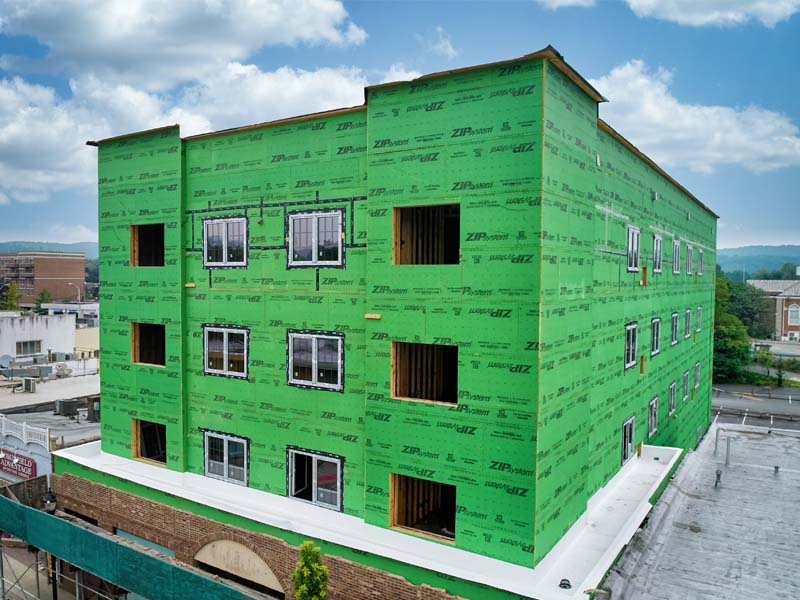
On a phased multifamily site, the first building may still fall under the prior edition while a later phase must follow the new code. Keep the contract date and target permit date with the bid documents for each phase.
New Jersey has its own version of the problem. Under the New Jersey Energy Code, assemblies and testing requirements must match the code in effect for that project. They can’t simply be carried over from the last job.
Delaware vs. Pennsylvania, Head to Head
Who actually enforces the code
Pennsylvania handles most UCC enforcement locally. More than 90% of the Commonwealth’s 2,562 municipalities administer and enforce the code through their own staff or certified third-party agencies. In municipalities that opted out, Pennsylvania Labor & Industry handles commercial enforcement, while certified third-party agencies handle residential work.
Delaware handles enforcement differently. The state sets the energy code, but counties enforce the building code. Chapter 52 covers unincorporated areas and 14 towns in Sussex County. On a Pennsylvania job, check with the municipality, and in Delaware, check with the county office.
Effective dates can be set at the county level
In Delaware, state adoption and the date a new code reaches a permit aren’t necessarily the same.
Sussex County’s updated notice sets April 11, 2027, as the effective date for the 2024 IECC for new homes, conditioned residential additions and accessory structures, and commercial buildings. Applicable plans also need an energy compliance worksheet such as REScheck or COMcheck.
New Castle and Kent counties may use different dates, so confirm each one before you finalize the spec or submittal package.
Compliance paths differ, and that changes the assembly
The energy code compliance path also affects the wall assembly.
Pennsylvania gives residential projects the 2025 PA-Alt provisions as another compliance option. In Delaware, residential projects follow the IECC, while commercial and high-rise residential buildings use ASHRAE requirements.
The paths don’t evaluate the wall the same way:
- A prescriptive path sets requirements for individual components.
- A performance path can allow the envelope to trade against mechanical performance.
The path can determine whether cavity R-value, continuous insulation, or whole-building performance governs the wall. It can also affect where spray foam insulation fits into the assembly.
Building a Spec Sheet That Travels
Verify the climate zone at the county level
Identify climate zones by county, not by state or city name. Use the county climate-zone lookup to confirm the climate zone by county for the code edition you’re using.
Pennsylvania has several climate zones, but Delaware has only one. Check the county before quoting the assembly so you don’t have to revisit it after the plan review.
Structure the spec by jurisdiction
A master spec can still work. It just needs to show where the requirements change.
Give each state a column for:
- Adopted code edition
- Effective date
- Enforcing body
- Compliance path
- Required submittal documents
Add a row for transition or grandfather cut-offs for each phase and another for the compliance reports needed at submittal. This keeps multifamily insulation submittals aligned with each phase’s permit schedule instead of using one timeline for the entire site.
Scopes that get missed when specs are copied across states
A few other scopes can get missed when a spec moves from one state to the next:
- Air sealing code requirements, envelope-continuity details, testing, and inspection expectations can change with the code. Match the air sealing scope to the code being used.
- Firestopping at rated assemblies and joints follows the building code, not the energy code.
- Multifamily sound-control assemblies may come from the building code and project standards, so the sound control insulation scope needs its own review.
- Steel framing can reduce a wall’s effective thermal performance below its nominal insulation value. The steel stud R-value breakdown shows why.
A Rule of Thumb
The spec follows the county. An assembly that worked on another job—even one in the same state—is only a starting point. For the current project, the county, code edition, effective date, enforcing authority, and compliance path determine what belongs in the wall.
A Five-Step Pre-Bid Check
Before the bid goes out, make sure you’ve covered five things:
- County: Which county is the project in?
- Edition: Which code edition applies?
- Effective date: Does the permit schedule fall under that edition?
- Compliance path: Which path is the project using?
- Submittal package: What does plan review require?
A PM can run through the list in a few minutes.
FAQ
Are Delaware and Pennsylvania on the same energy code edition?
No. Pennsylvania is on the 2021 I-Codes as of Jan. 1, 2026. Delaware moved to the 2024 IECC and ASHRAE 90.1-2022 in April 2026.
Can I still permit a Pennsylvania project under the older code?
It’s possible. If you signed your design or construction contract before January 1, 2026, and filed your permit application by June 30, 2026, your project may still follow the previous code. Some municipalities have earlier deadlines, so check your local requirements.
Who enforces the code on my Pennsylvania project?
Usually the municipality. More than 90% of Pennsylvania municipalities enforce the UCC locally. In opt-out municipalities, Labor & Industry handles commercial work, and certified third-party agencies handle residential enforcement.
When does Delaware’s newer energy code hit my permit?
That depends on the county. In Sussex County, the 2024 IECC takes effect April 11, 2027. Plans that fall under the new code also need an energy compliance worksheet such as REScheck or COMcheck.
Is Connecticut on a newer code yet?
Not yet. Connecticut is still using the 2022 State Building Code, which is based on the 2021 I-Codes. Its next code cycle has been delayed.
Before the Spec Goes Out to Bid
Before the spec goes out to bid, check the code edition, effective date, and enforcing authority for that jurisdiction.
Builders and developers working in New York, New Jersey, Pennsylvania, Connecticut, and Delaware can have their multi-family insulation, air sealing, and firestopping scope reviewed by jurisdiction before submitting the bid. Teams can also request a bid from Hudson Insulation before the project reaches plan review.
References
“Building Energy Codes.” Delaware Department of Natural Resources and Environmental Control, dnrec.delaware.gov/energy-climate/efficiency/building-energy-codes/.
“Building Code.” Sussex County, Delaware, sussexcountyde.gov/building-code.
“Uniform Construction Code (UCC).” Pennsylvania Department of Labor and Industry, www.pa.gov/agencies/dli/programs-services/labor-management-relations/bureau-of-occupational-and-industrial-safety/uniform-construction-code-home.
“Code Update Training.” Pennsylvania Housing Research Center, Penn State College of Engineering, www.phrc.psu.edu/industry-education/Resources/Code-Update-Training.aspx.
“About the Connecticut State Building Code.” Connecticut Department of Administrative Services, portal.ct.gov/das/services-for-agencies-and-municipalities/safety-codes-and-inspections.
“Building and Fire Code Adoption Process.” Connecticut Department of Administrative Services, portal.ct.gov/das/office-of-state-building-inspector/building-and-fire-code-adoption-process.
“29 DE Reg. 875: Regulations for State Energy Conservation Code, Final Order.” Delaware Register of Regulations, vol. 29, 1 Apr. 2026, regulations.delaware.gov/register/april2026/final/29%20DE%20Reg%20875%2004-01-26.
Wright, Andy. “Delaware Energy Code Adoption Update.” Sussex County Building Code Office, 20 Aug. 2026, sussexcountyde.gov/sites/default/files/PDFs/2026_IECC_Public_Notice.pdf.”2025
Pennsylvania Alternative Residential Energy Provisions Update: Special Webinar Handouts.” Pennsylvania Housing Research Center, Penn State College of Engineering, 24 June 2025, www.phrc.psu.edu/assets/docs/Webinars/PHRC-Webinar_2025-Pennsylvania-Alternative-Residential-Energy-Provisions-Special-Webinar_Handouts.pdf.
“Delaware: State Profile.” Building Energy Codes Program, U.S. Department of Energy, www.energycodes.gov/status/states/delaware.